Showing posts with label MMORPG. Show all posts

Tuesday, June 29, 2010

Cory Doctorow - For The Win & Copyright Issues


Managed to see Cory Doctorow twice during a book tour promoting his latest novel, For The Win (of which I now have a signed copy), about gold farmers in a virtual MMORPG organizing as a union. The first was at a Baltimore book store where he gave a reading and then a Q&A with the audience that was highly entertaining.


The second was at the New American Foundation for a lecture on copyright and another long Q&A.

Video embed below.


Although often introduced as a prolific blogger (from Boing Boing) and novelist, his public speaking is extremely engaging. His energy when discussing issues around science fiction, copyright issues, creative commons, and corporate control of creativity is impressive.

Almost politic.

Cory for Prime Minister?

P.S. He mentioned that Fred Lohmann from EFF had moved to Google? I remember Fred's lecture on copyright issues at the 2006 New York Machinima Festival.

Now all I have to see is author Neal Stephenson and I will have seen a quartet of cool scribblers.

Friday, September 25, 2009

Love Is Back

And better than ever.

The procedural MMO I talked about before is presented in a 10 minute video by the creator.


The editing and in-world building tools look fantastic, as does the art and procedural generation. Who knew something that looks so simple could end up being so complex.

Bonus news, an alpha client is available for download and testing (no network).

Friday, August 07, 2009

Monday, July 21, 2008

Love - The MMORPG

I mentioned this briefly before, but this one-man game engine that uses procedurally animated for a MMORPG has an astounding and unique look to it.


Wired has some more info.


The tools used to create the game look interesting too, almost art

Massively.com has an article earlier this year.

Can't wait to see what impact this has on machinima.

Tuesday, June 26, 2007

Friday, December 01, 2006

Friday Nite Roundup

A collection of links of interest:

1. MMORPG company goes bankrupt. Players want to buy to buy the game (from the BBC).
2. The Antikythera Mechanism has been solved (world's first computational device? - how long before a copy shows up in SecondLife? - via NYT).
3. Fox News to interview Angel Munoz (from CPL). Is this good,or bad? How will Fox News treat the concept of playing video games in a tournament. Freak of nature style news reporting, or video games are bad and are subverting our youth style news? (via GotFrag).
4. 3DFilmMaker reports that machinima is topping the list of gaming innovation awards.
5. There.com has a machinima festival (have not finished watching all of the entries yet - There looks a lot like Second Life).

The digital revolution is of course sweeping through the filmmaking industry, ripping it apart from the inside like a syncytial virus. How long before the actual process of filmmaking no longer uses film at all? When will the last big budget Hollywood film be shot on film (future Jeopardy trivia question). How many Final Cut Pros does it take to make a blockbuster?

Friday, November 10, 2006

Some Interesting News In Game Development

1. Via Clickable Culture, we have news that Telefilm Canada will be promoting Canadian videogame development through a competition. The final prize will be 500 K although final details have not been announced (webpage here). It will be interesting to see what comes of this as there are some great Canadian game companies (Relic, Bioware, Ubisoft Montreal, EA Canada, and Rockstar North to name a few), although most are offshoots of larger entities. On the other hand, the Canadian government's idiotic bureaucracy should almost ensure that the entire venture will fall flat (disclaimer: I am Canadian).
2. White Wolf (World of Darkness) and CCP (Eve Online) have announced a merger. Each will use their respective expertise in their own arenas to capitalize on the IP of the other (CCP will develop a MMORPG based on WoD, while WW will help develop more traditional gaming, strategy guides, pen and paper RPGs, and CCGs, based on Eve Online?). Again, I am simply looking forward to seeing how this turns out. I never delved much into WW's games, although I was a big fan of Rage the CCG back in the day and I certainly have not yet ventured into Eve Online, although it certainly produces it's fair share of announcements and stories. Will this cross platform promotion fuel growth in each company's respective audiences? or again, will this fall completely flat.

UPDATE! The 10 finalists for the Telefilm Canada competition have been announced (via Clickable Culture).

Tuesday, May 30, 2006

Wow versus Counterstrike

MMOGCHART has released a new update. Obviously World of Warcraft dominates the MMOG market, as these charts show (1, 2, 3, 4). This reminds me of another game that dominates it's respective genre, Counterstrike. If you check the Gamespy stats, you can see that the various incarnations of CS account for the largest chunk of FPS gamers playing online. Although CS activity has dropped in recent years, let's not forget that it was first released in 1999, almost seven years ago! That type of longevity is not to be laughed at. I suspect WoW will have a similar track, at least until WoW2 comes out, and considering the first expansion has not yet been released, I expect that will be years from now.

So what do these two games have in common that makes them so dominating in their respective fields? Both games are extremely easy to get into and play. They are easy to learn, but difficult to master, and the high level play in CS (both professionally in leagues like the CPL, and on normal pub servers) matches the high level of play that can be found in high end instances in WoW. Both of them are unbelievably addictive, as I can attest to personally. One other important reason is the breaking point in the history of both games where they became so popular that a tipping point was reached which contributed to the game's popularity by virtually forcing the formation of large gamer communities. For CS, that meant that many of your friends were playing, it was easy to find servers to play on, and countless clans and websites sprang up around this community. A similar spike in popularity occurred with WoW, although all servers are owned by Blizzard, but many players and guilds popped up. Contrast this with a game like Quake 4 which has almost nobody playing (according to Gamespy again, less players than Quake 3) and you can barely find a server to play on with a ping less than 200. Guess which one the average user is going to play, the one where he is playing with nobody he knows, or the one where his friends are playing.

Finally, the most important reason for their popularity is that they are both fun to play. Of course my idea of fun in WoW died out after 3 months, whereas I still play the occasional game of CS. Fun is a relative thing, but enough people found these games enjoyable, although they are not for everyone.

I haven't listed any of the details that made these two games so great, like simple and intuitive interfaces (although that's debatable in WoW), ability to ease newbie players into the game via training, the gentle learning curve (which ramps up exponentially) etc. However, I wish more game companies would pay attention to these details so that a larger selection of games at least matched the professionalism of CS and WoW (and it can't be that hard, CS was started by two guys as a Half-Life mod), even if they don't end up matching the overall popularity.

Monday, May 08, 2006

Guild Wars Factions


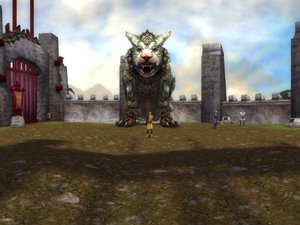
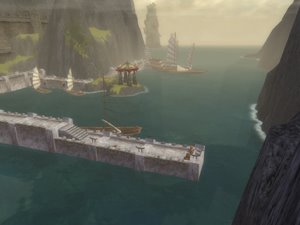
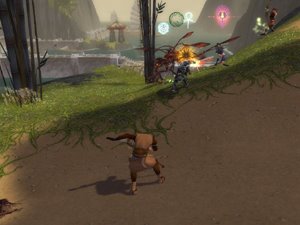
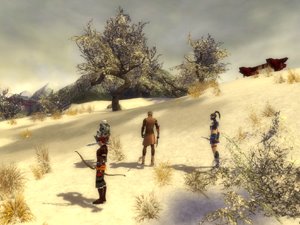
I have been playing an excessive amount of Guild Wars: Factions lately. GW was a groundbreaking MMORPG developed by Arenanet for NCsoft, although some people have argued that the massive and multiplayer in that acronym do not truly reflect GW. This is due to the fact that GW does not really have a persistent world such as the one you would find in World of Warcraft. Instead, players connect with each other in various towns and cities, group together, and then head off into an instance to adventure, kill enemies, collect loot, and finish quests. Each city is a portal to the rest of the world, all of which is instanced, including both the PVE (player vs. environment, where the monsters roam) and PVP (player vs. player - where that 12 year old who just hacked your head off roams).


GW is noteworthy for a few things besides the large amount of instancing. For one thing, there is no monthly fee, which is almost unhead of in MMORPGS these days. Arenanet will attempt to release full price expansions every six months to generate revenue to support this. This lack of monthly fees is also one of the reasons why there is so much instancing in the game as it is simply cheaper to produce instanced content than it is to produce a persistent world. In addition, each expansion is fully playable by itself, meaning you could pick up the first expansion, Factions, without ever having purchased the original game. Of course you cannot access all of the content present in the original, but it does open up the option for demoing the game without having to purchase all previous expansions.


GW is also noteworthy for the exquisite graphics found in the game, which are very lifelike, unlike the cartoony graphics found in WoW.


I find the most interesting thing about GW to be none of the above elements. Instead, it is the absolute freedom to construct your character however you want that has both drawn me to, and kept me playing, GW. I'm a big fan of freedom in games as I attested to in an earlier post. Unlike WoW, where your character class completely defines how you play the game (I played an Orc Hunter to Lvl 45) GW allows the the player unprecedented freedom in how you play. One of the biggest differences between the two games is how skills are used. In WoW, there are a large set of skills to use, most of which are useless 95% of the time. In GW, there is also a large set of skills to choose from, but you can only bring 8 at any one time into an instance. This forces you to specialize, but it also allows a great deal of freedom in how you play your character. This may seem counterintuitive, but the underlying game mechanic is brilliant.

Each character class in GW has a set of main branching skillsets, usually around 4. The primary attribute is specific to the class, while the rest can be used by any secondary class. In GW you can have both a primary and secondary class, which means you have access to the primary skillset, and all other skills from your primary class, and the rest of the skills from your secondary class, which means you have 7-9 different skillsets. From these skillsets (around 150 in Prophecies, and up to 180 with the addition of Factions) you choose 8 specific skills. Each branching skillset has a linked attribute, which typically increases the power of skills in each skillset. Practically this means you can only pump up the attributes from 2-4 skillsets at any one time although you can freely alter the attribute levels for your character when you are in any portal (town, city, outpost) for free. In WoW, however, it costs increasing amounts of gold to respec, and you typically only have one primary, and one secondary skill tree. The amount of freedom is extremely limited in WoW as you cannot just play around with the skill tree, and there really are not that many different ways you can play your class. These dual barriers made WoW exceptionally dull to me.


Let's take a healer, for example. In WoW, the priest's only job is to heal and that's it. In GW, the monk can be a healer, a protector, or a smiter (damage dealer). There are many different ways of achieving each of these three types, and players constantly reshuffle their skills and attributes to find a way of playing that they are comfortable with. When you add in the secondary skillsets, then the amount of possible combinations becomes mind-blowing, and players delight in finding new and creative mixes to try out (check out the skill descriptions at gwonline). As a specific example, I could decide I want to be a smiter, using 5 skills from the smiting line, and then add some skills from the Mesmer class which allow me to regain energy, thereby allowing me to cast more spells more frequently and increasing the damage output of my character. If I find that I didn't like the way the character played I can rezone to the nearest portal (or any town on the map) and respec my character, say switching the Mesmer skills out for some protection ones from the monk, thereby allowing me to live longer. It's completely up to each player, although I think this causes those who want a step-by-step set of instructions on how to play a great deal of consternation (you know the type, those who post on the forums without reading a single FAQ or article asking for the "best" character, or the "best" skills to play). For those who don't want to think, go play WoW, for those that do, play GW.

On a sidenote, the Factions expansion pack has a distinctly Asian feel to it. That may have something to do with the large audience NCsoft has in the Korean market as reported at Next Generation. It will be intriguing to see where Anet goes with the next expansion packs, which are reportedly being worked on concurrently, with two development teams leapfrogging each other on expansions. Will we see a more typical fantasy setting or something more exotic?

Tuesday, May 02, 2006

Another economic breakthrough

There is an article in the New York Times today (which I won't link to since it requires registration [just search google news], I will however link to MMORPG blog which also has the story and the BBC, which is a better news organization than NYT anyways) about another virtual world, in this case Project Entropia. Mindark, the Swedish developer has introduced a real world automated teller machine (ATM) card which allows players to access their in-game bank accounts through a real world banking machine (note that there will apparently be a transaction fee). Bingo!

Project Entropia is one of the only other virtual worlds that actively promotes the exchange of real world money for virtual dollars (and vice versa). In fact, I believe their entire business model is built around the idea of skimming the fat off the top since there is no subscription fee and no cost to download the client (unlike SL which requires you to pay a monthly fee in order to engage in higher economic functions like owning land). Since they stated that last year approximately $165 million was exchanged in PE, then 1.5% of that is approximately $2.5 million (that is if they take 1.5% off of every exchange, and that 1.5% is a flat rate). Many of the articles state that there are around 250 000 subscribes (although I cannot find any independent confirmation of those numbers, even on MMOG chart). So if PE generated $165 million for 250 000 in 2005, and SL generates approx $500 000 per week (or $2 million per month, or $24 million per year) for approx. 200 000 people (as of recently) then it sounds like PE has the better economy ($660 per resident per year vs. $120 per resident per year). I am not entirely sure of those numbers, so if someone has conflicting information, then please let me know.

PE was famous in the mainstream media for two other noteworthy events. One was an island that was bought ($27 000) by one of the players who sold/rented parts of it to residents, and another was a person who bought a space station ($100 000) and is also selling/renting parts of it as well as opening a nightclub. Apparently both are doing very well and have made their money back (at least the island has, and the space station sounds like it is well on its way).

I predict a number of things will happen in the future.

  1. more and more mainstream stories will pop up about virtual economies (boring)
  2. someone somewhere is going to get bitten hardcore, and lawsuits will quickly follow (who's responsible for making sure I get paid? what if I get ripped off?)
  3. SL or PE will be bought out by someone else (maybe Ruper Murdoch, maybe Yahoo or Google)
  4. this type of cash attracts big money like thrashing in the water attracts the sharks, watch out for some serious underhanded tactics (who regulates real world economies? can you get insurance?)
  5. you're going to get taxed (start a K street lobby group to make sure your congressman doesn't tax this economy booster!)

Wednesday, April 26, 2006

The best things in life are free

There is an enormous list of free to play/try MMOGs at mmolist. Although not an MMOG by any stretch of the imagination, I highly recommend Allegiance. Microsoft, of all companies, released it for free (including the source code) awhile back. There is a steep learning curve, however, and it may take some time getting used to all of the gameplay elements. With games like BF2, however, I think that a lot of the novel elements that were in place when Allegiance came out are more acceptable/known to the gamer community.

Groundbreaking gameplay elements included a commander who controls the technology tree, miners who help mine resources for your side, and various combatants who fly everything from small nimble fighters to larger attack craft (wikipedia entry here).

Sunday, April 23, 2006

The Next Generation of Gaming

Raph Koster posted some speculations on where this is all heading. Similar ideas have been passed around before, that the production costs for mainstream video games are ballooning out of control and will simply be too expensive for most publishers and developers. Personally, I think that these same publishers and developers brought this on themselves with their overemphasis on eye candy and graphical splendor over any sort of gameplay whatsoever.

My idea is that there should be open source development. Let the gaming company produce the infrastructure, and then let all the amateur level designers and modders produce most of the content. What would an MMORPG look like if it was moddable but had a basic framework in place that allowed questing, leveling, etc? I'm not talking about Second Life, which allows for a large amount of user-generated content, but something like WoW or Guild Wars, where most of the quests/missions were created by the players themselves? SL unfortunately is not a game. What if Orgrimmar was entirely player-created, from the buildings, to the personnel, to the quests handed out? What if you had to go kill 10 Elder Panthers because Gimpy the Dwarf (another player) really needed you to kill those 10 cats in exchange for 5000 XP or 10 gold? What if there actually was a war being fought in WoW, and supplies really did need to be moved from behind the lines to the front where they were most needed? What if that Sword of Slaying I held aloft before crashing into the battle lines was created by Darok Forgemaster entirely, from the iron bars I gave to him, to the glowing ruby in the pommel, to the textures he uploaded to the server so that everyone else can see the fine grain of the steel before it swipes off their head?

What if, what if?