Saturday, April 29, 2006

Dystopian visions

Dystopia, the winner of the Independent Games Festival HL2 Mod of the Year, has become a favorite of mine. I think that it springs from two reasons.

  • 1. The darkly cyberpunk vision is something that is not found in the me-too WWII mods that are found almost everywhere else.

  • 2. The game vaguely reminds me of Tribes, which in my opinion was one of the best games ever made.
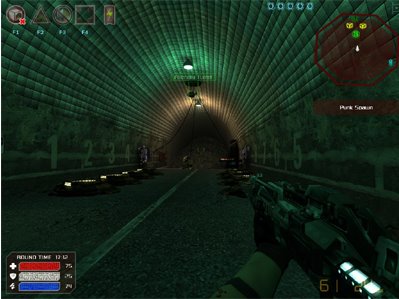


  • The second reason is noteworthy for the same reason that I found Tribes so compelling. The game allows the user the absolute freedom to define their role in-game. Unlike BF2, where you select a class that completely predefines your role on the battlefield, Dystopia and Tribes provide a wealth of choices. Both allow 3 types of armor (light, medium, heavy) and a wide selection of weapons (although some are limited by class). In Tribes you could choose various packs (although only one per armor) that provided benefits on the battlefield. Some favorites were the energy pack (energy for skiiing across the landscape), the repair pack (for turret monkeys to repair turrets and defensive teammates) and the shield pack (for heavies on the flag). In Dystopia there are a lot more modules to choose from, but there is an inverse relationship between armor and modules. Light armors have the widest selection, including the cyberdeck, while the heavy armor has the least amount of selection. In Tribes the heavier the armor, the more weapons, while in Dystopia the weapons are limited for all armors (mostly one main, one sidearm, and a few extras like grenades).

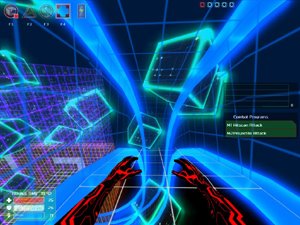
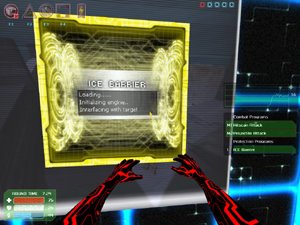
    The cyberdeck is one of the unique aspects of the game. Hackers can login to a computer terminal and enter cyberspace, a realm where the normal rules of physics do not apply. Hackers can then access various components such as turrets, doors, and spawn points and change access for their side. Hackers can also encrypt components under their control, which forces their opponents to spend valuable time and energy hacking their way around these security blocks.

    Another distinguishing feature are the stealth packs that result in a Predator-like stealth field around the player, rendering them virtually invisible to their opponents. In order to combat this there are TAC scan modules (all enemies show up on radar for a brief period of time), and a visual scanning module that shows ememies up in infrared. These options provide for a great deal of tactics in the game that are not normally found beyond the need to kill your opponent in other games, and it makes the game both more thought-provoking and more frustrating, especially when dealing with people who have no idea what they are doing.
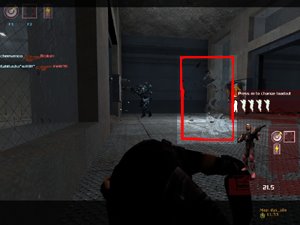
    There's a basic player guide here, and a forum where people can find answers to their questions. I look forward to seeing where this mod goes in the future, and especially hope that more great maps come out to provide some options for playing.

Friday, April 28, 2006

More virtual libraries

My previous post about enabling a virtual library in Second Life and this post yesterday at DigiCMB made me want to learn more, so I wandered http-wise over to the Second Life Library 2.0 blog and followed their SLurl link.


Arriving SL-wise, I found myself surrounded by some lovely shrubbery and a donation box. Entering the library I was greeted by a librarian (Seraphima Salsman) sitting at the reference desk. Later we were joined by another librarian (Curious Witte) who appeared as a glowing sphere (I'm envious as I've always wanted to be a glowing sphere).


The library is very nice, although it is undergoing construction. Virtual construction is far easier on the auditory system than RL construction as I was not assaulted by the sounds of jackhammers as I am in the real world. Here a designer (Lorelei Junot) has just added a lovely cushiony seating area for a test.


On the roof is a viewing area, with some seats and a large screen (to show the Superbowl in HiDef?) and what looked like an addition to the library. Turns out it was a book vendor who had set up shop on the roof to charge for some rather old texts like Plato's The Republic (copyright doesn't last that long, does it?).


The contents of the library are fairly small right now, but will continue to grow into the future. My question was, what process did they use to get the texts into SL? Were these texts already in digital format, and just needed to be converted, or were they converted solely for the purpose 0f this project?

What I was really interested in, but did not have time to get into, is the idea of information architecture. How can people use the virtual space to organize and present information in a meaningful way? Are there ways that go beyond what can currently be done in RL so that information processing occurs more rapidly and seamlessly. In a current library you can search a card catalog, browse the books on a shelf, ask a librarian for help, or do the search digitally (the most common way now) on a computer. However, what you get back, in the case of your standard community library is a book. Now don't get me wrong, I love books and have many on the bookshelf behind me. However, for the purpose of presenting information, they leave a little to be desired. You can't search within a book, for example. Well, you can, by using an index (if it has one), but the combersome method of flipping back and forth from the index, trying to find the correct term (for the book, which may or may not be what you imagined it) and the text is painful. Who wouldn't love a google search option built on top of the cover? Or an interface like Hitchhiker's Guide to the Galaxy? Or better yet a voice recognition system like the one in Star Trek?

This problem becomes even more dramatic when we are dealing with more complicated data than simple fiction, or even textbooks. There is an enormous amount of data that exists in the digital realm, and I think utilizing the virtual world to organize it cohesively, present it as more than just a representation in RL (which would be flawed, since most digital data is shown flat on a 2D computer screen), and bring about something like the Cyberspace idea envisioned in William Gibson's cyberpunk books is the way forward. It will be interesting once Linden Labs gets web access into SL and seeing what people do with that. The Shifted Librarian (I can read the blogpost now!) has some of the same questions. However, just recreating the web in SL is only one step, and a larger one is reconfiguring the interface and content for a full-blown 3D representation (and no, that doesn't mean recreating a computer monitor in SL - mirrors of mirrors we do not need).

Thursday, April 27, 2006

Machinima day

Two noteworthy events: the first episode of the machinima film Bloodspell was released yesterday, and there is a set of 4 short videos of an interview with Paul Marino that were taken at the State of Play Conference last fall available.

Bloodspell is the work of Strange Company, a group that has been doing machinima for longer than most people have been playing games. Their list of films include Ozymandias, and Matrix 4X1. The director is Hugh Hancock and he both coined the term 'machinima' and founded machinima.com Their latest work has been crafted with the game Neverwinter Nights and an enormous amount of work has gone into creating new characters and new art for their production. Interestingly, Bloodspell has been released under the Creative Commons licence so feel free to mix it up. I was a little put off by the animation in NWN, as it looks fairly old school. It remains to be seen how well Bloodspell actually does in the long run as it will be episodic.

The short interviews (1, 2, 3, 4) with Paul Marino focus on the history as well as the future of machinima. There's an interesting mix of where we have come, including the description of the Warthog grenade jumps from Halo, as well as the use of machinima in Second Life to promote products. Paul Marino's blog, Thinking Machinima, is a place where he promotes machinima (it hasn't been updated in over a month, get cracking!), and he is also the director of the Academy of Machinima Arts and Sciences (Hugh Hancock from SC is also on board) and the author of the book The Art of Machinima. I wish I could have watched the entire interview instead of just these four short pieces.

Machinima is becoming more mainstream and it will be an exciting time to see what people will do with this new art form, both technically (there are things you can do in machinima that you can't do in real film, or would be prohibitive to do in a classic animation form) and more importantly, artistically.

Wednesday, April 26, 2006

The best things in life are free

There is an enormous list of free to play/try MMOGs at mmolist. Although not an MMOG by any stretch of the imagination, I highly recommend Allegiance. Microsoft, of all companies, released it for free (including the source code) awhile back. There is a steep learning curve, however, and it may take some time getting used to all of the gameplay elements. With games like BF2, however, I think that a lot of the novel elements that were in place when Allegiance came out are more acceptable/known to the gamer community.

Groundbreaking gameplay elements included a commander who controls the technology tree, miners who help mine resources for your side, and various combatants who fly everything from small nimble fighters to larger attack craft (wikipedia entry here).

Tuesday, April 25, 2006

Gaming history

An excellent article in issue #42 of The Escapist dealing with the history of board games. Written by Greg Costikyan of Manifesto Games, it covers everything from the first recorded instance of a board game developer in 1759 through to the continued impressive board game market in Germany and the influence board games and their developers have had and continue to have on the computer games industry.

From personal experience, the name Civilization might invoke thoughts of Sid Meier's venerable PC title (now in it's fourth iteration, Alpha Centauri notwithstanding). Few people might know that Sid based his version on a board game developed by Francis Tresham for Hartland Trefoil and sold in the US by Avalon Hill (now sadly out of print, although sometimes copies can be found on eBay) called, oddly enough, Civilization (and Advanced Civilization, see Wikipedia entry here). I have spent many a rainy Saturday with friends whiling away the hours playing this superbly balanced and yet incredibly fun game. Although not a war game per se, it mixed a fantastic blend of population and economic expansion, trading, scientific development, and political intrigue. Personally I've always found the Civ PC games to be a pale comparison to the board game mostly due to the fact that the PC game is played almost entirely in single player mode, while the board game was played with up to 8 like-minded scheming underhanded fellow humans. No AI programming can match that.

There is an old computer game version of Advanced Civilization by Avalon that is still available at a few places if you know where to look. I wouldn't recommend it since it suffers the same problems that afflicts Sid's game, namely a lack of human presence. There's nothing like trading away a civil war to somebody in order to get the last salt on the board to complete a set (and watching your opponent's crestfallen face as he realized that you lied to him about the commodity you were trading him).

Xfire -> Viacom

Viacom has acquired Xfire for 102 million (news found everywhere right now). Xfire consists of a suite of tools for online gamers that allows them to browse servers, connect, IM friends, voice chat, etc. 102 million for the rights to access the eyeballs of 4 million mostly male, mostly young, hardcore gamers with loads of dispensable income. Direct targeted advertising especially with the usage stats that Xfire has. I'm surprised that Valve has not done a similar thing with Steam as of yet but I suspect that it is coming soon.

Monday, April 24, 2006

Connecting the real and the unreal

A post today via DigiCMB about connecting avatars inside Second Life (SL) to libraries, both the brick and mortar kind and to certain online services (note I cannot read the post on TheShiftedLibrarian right now as it seems to be down). This may open an entire new realm of using SL as more than just a 3D chatspace and being able to engage in RL business, teaching, and learning. Will I soon be able to order a book from my local library (or, how long before you can pay your bills for RL in SL?, or jump into Amazon and order a book?).

I'm waiting for the time when you can pay for and take classes at a prestigious institute like MIT in SL (for those who don't know, MIT releases most (all?) of its course content (lecture notes, handouts, problem sets) at OpenCourseWare). Imagine watching some scientific or political leader pontificate on weighty subjects by watching in SL. Forget taking notes on my laptop (or heaven forbird, with a pen and paper), I just want to download the notecard!

I suspect, however, that these great ideas that we have for SL, or just about any virtual space, will soon be surpassed by commercial aspects. I remember reading an article where a journalist had asked a number of people what they thought the internet would eventually be used for (this article took place around the same time that Mosaic, the web browser, was just taking off), and many thought it would be used to educate and inform. Very few of them predicted the massive commercial interests such as Amazon's or the giant networking sites like MySpace were mentioned whatsoever.

(Note, I'm writing this while listening to SecondCast, episode 15, at the point where Hamlet mentions that so far the outreach he has been engaged in with news organization almost always focuses on how people can make money in SL).

Sunday, April 23, 2006

The Next Generation of Gaming

Raph Koster posted some speculations on where this is all heading. Similar ideas have been passed around before, that the production costs for mainstream video games are ballooning out of control and will simply be too expensive for most publishers and developers. Personally, I think that these same publishers and developers brought this on themselves with their overemphasis on eye candy and graphical splendor over any sort of gameplay whatsoever.

My idea is that there should be open source development. Let the gaming company produce the infrastructure, and then let all the amateur level designers and modders produce most of the content. What would an MMORPG look like if it was moddable but had a basic framework in place that allowed questing, leveling, etc? I'm not talking about Second Life, which allows for a large amount of user-generated content, but something like WoW or Guild Wars, where most of the quests/missions were created by the players themselves? SL unfortunately is not a game. What if Orgrimmar was entirely player-created, from the buildings, to the personnel, to the quests handed out? What if you had to go kill 10 Elder Panthers because Gimpy the Dwarf (another player) really needed you to kill those 10 cats in exchange for 5000 XP or 10 gold? What if there actually was a war being fought in WoW, and supplies really did need to be moved from behind the lines to the front where they were most needed? What if that Sword of Slaying I held aloft before crashing into the battle lines was created by Darok Forgemaster entirely, from the iron bars I gave to him, to the glowing ruby in the pommel, to the textures he uploaded to the server so that everyone else can see the fine grain of the steel before it swipes off their head?

What if, what if?

Save the internet!

Do not let anyone control what you can see, read, download, comment on, or pass around...Save the internet is a site to organize resistance to these idiotic measures that the lobbyists have effectively put in place via the representatives that are in their back pockets. Combat censorship! Do not let more control pass from the hands of the people to those with the biggest checkbooks.

Saturday, April 22, 2006

Real life dollars for virtual pixels

Lots of coverage this week about the Second Life land baron Anshe Chung. Mainstream press article in Business Week (and cover image), with blog posts at Terra Nova, and We-Make-Money-Not-Art. Nothing too terribly exciting about this, although greater mainstream coverage is always a good thing. If I were a grad student in economics I would seriously consider studying SL as it grows.

I'm waiting for the day when we have an Enron or MCI type scandal in a virtual economy that wipes out people's pension plans, 401Ks, and results in a trial (in the real world or the virtual?), and somebody makes a movie about it. Then the government steps in and regulates the entire thing so that it grinds to a halt.

Get on board now before that happens!

Welcome


My first post on this brand spanking new blog! Welcome all!